
Skill-Based Recruiting: The Complete Guide to Skills-Based Hiring in 2026
Recruiting is harder these days. There is more competition and less talent. Or is there? Maybe what you need to do is change who you recruit.
TrueAbility
TrueAbility
Skill-based recruiting is how organizations stop guessing who can do the job, and start knowing.
But most teams that adopt it in theory still rely on weak evaluation methods in practice. This guide covers what skill-based recruiting actually is, why it’s replacing traditional hiring, and how to implement it in a way that produces results.
What Is Skill-Based Recruiting?
Skill-based recruiting is a hiring approach that evaluates candidates based on their ability to perform real-world tasks — not just their resumes, degrees, or job titles.
Instead of asking “Where have you worked?”, it focuses on a more important question: can this person actually do the job?
For many organizations, this shift is driven by a simple reality: traditional hiring methods don’t reliably predict performance. As a result, skills based recruitment is emerging as a more effective way to identify candidates who can succeed in real-world roles. Organizations adopting this approach consistently see stronger performance, better retention, and more inclusive hiring outcomes.
Who Is Skill-Based Recruiting For?
Skill-based recruiting is relevant for any organization that hires for roles where demonstrated ability matters more than credentials. Which, in 2026, is most of them.
It’s particularly high-impact for:
Technical roles where on-the-job performance is difficult to predict from a resume alone — engineering, DevOps, cloud infrastructure, cybersecurity.
High-volume hiring where inconsistent screening creates bottlenecks and bad hires at scale.
Organizations expanding globally where degree equivalency is difficult to assess across education systems.
Teams focused on workforce diversity where credential-based screening systematically excludes capable candidates from nontraditional backgrounds.
If your hiring process produces inconsistent results, or if you’re losing candidates to faster-moving competitors, skill-based recruiting is worth a serious look.
Why Skills-Based Recruiting Is Replacing Traditional Hiring
Traditional hiring methods were built for a different era — one where degrees and job titles were treated as reliable proxies for ability. Today, those signals are increasingly unreliable.
This shift is being driven at a macro level as well — research from McKinsey & Company shows that demand for demonstrated skills is rapidly outpacing reliance on traditional credentials across industries.
A 2024 analysis by the Burning Glass Institute found that companies that dropped degree requirements did not see a meaningful increase in degree-holding hires. They saw an increase in hires from nontraditional backgrounds who performed as well or better on the job. The credential wasn’t predicting performance. It was filtering people out.
Organizations adopting skill-based recruitment models are doing so to solve four persistent hiring challenges:
Expands access to talent. Removing unnecessary degree and experience requirements opens the door to capable candidates from nontraditional backgrounds — self-taught developers, bootcamp graduates, career changers with transferable skills.
Improves hiring accuracy. Evaluating real-world performance leads to better on-the-job outcomes and fewer costly hiring mistakes. When you measure what someone can do, you get a cleaner signal than a resume provides.
Reduces bias in hiring. Resumes often reflect access and opportunity — not capability. A skills-based model shifts evaluation toward objective, task-based criteria that are harder to game and easier to defend.
Accelerates time-to-hire. Standardized evaluation processes reduce bottlenecks and enable faster, more confident decisions, because everyone is being measured against the same criteria.
Skills-Based Recruiting vs. Traditional Hiring
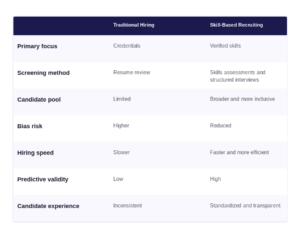
Traditional hiring assumes ability.Skills-based recruiting proves it.
How to Implement Skills-Based Recruiting
Adopting skills-based recruiting requires more than removing degree requirements — it requires a structured system for evaluating capability.
Step 1. Define Role-Specific Skills. Break each role down into the competencies, technical skills, and tasks required for success. Be specific — “strong communication skills” is not a skill definition. “Can write a clear incident report under time pressure” is. The more precisely you define what success looks like in a role, the easier it is to design assessments that measure it. And the more defensible your hiring decisions become.
Step 2. Remove Non-Essential Requirements. Audit every requirement in your job postings. If a requirement doesn’t directly impact performance in the role, remove it. Degree requirements, years-of-experience thresholds, and specific tool preferences are common culprits. They filter out capable candidates without adding predictive value.
Step 3. Introduce Real-World Assessments. Replace or supplement resume screens with hands-on exercises, job simulations, and scenario-based problem solving. The assessment should reflect the actual work, not a proxy for it.
This is where most teams underinvest. A poorly designed assessment produces noise, not signal. See the section below on measuring real-world ability.
Step 4. Standardize Evaluation. Use structured interviews with consistent questions, scoring criteria, and clear rubrics across all candidates for a given role. Unstructured interviews are one of the most common sources of bias in hiring, and one of the easiest to fix.
Step 5. Train Your Hiring Teams. Skill-based recruiting requires a different mindset from interviewers and hiring managers. Without training, teams default to pattern-matching on resumes and gut instinct — undermining the system you’ve built.
Step 6. Validate Outcomes. Track performance, retention, and hiring accuracy over time — and use that data to refine your process. If candidates who score well on your assessment don’t perform well on the job, the assessment needs to change. Skill-based recruiting is a system, not a one-time fix.
The Missing Piece: Measuring Real-World Ability
Many organizations adopt skills-based recruiting in theory but rely on weak evaluation methods in practice.
The most common gap is simple: they measure knowledge, not performance.
Multiple-choice tests, resume screens, and unstructured interviews don’t reflect how candidates perform in real-world environments. They measure what someone knows or says — not what they can do under realistic conditions.
High-performing teams are shifting toward performance-based assessments, live simulations, and hands-on validation. The difference in signal quality is significant. A candidate who can explain how to troubleshoot a network failure in an interview is not the same as a candidate who can actually do it inside a simulated environment — under time pressure, with incomplete information, using real tools.
That gap is where bad hires happen.
How Leading Teams Assess Skills Effectively
Modern hiring teams use a combination of evaluation methods calibrated to the role:
Technical assessments evaluate engineering, DevOps, or data skills through real tasks — not theoretical questions. The environment matters: candidates should work in tools they’d actually use on the job.
Simulation-based exercises test performance in realistic, role-specific scenarios. A customer success simulation might present a difficult client interaction. A sysadmin simulation might present a live server with a misconfigured service.
Role-specific case studies assess decision-making, communication, and problem-solving in context. These work well for roles where judgment matters as much as technical skill.
Structured interviews use consistent, behaviorally anchored questions scored against a rubric — replacing the unstructured conversations that introduce the most bias into hiring decisions.
Performance-based platforms like TrueAbility enable teams to create real-world testing environments, standardize evaluation across locations and hiring managers, and measure actual performance rather than self-reported ability.
Where Skills-Based Recruiting Goes Wrong
Even well-intentioned teams struggle to implement skills based recruiting effectively.
Unclear skill definitions. Without clear benchmarks, evaluation becomes inconsistent. And inconsistent evaluation is just bias with extra steps. Every role needs a defined picture of what good looks like before assessment design begins.
Overreliance on interviews. Unstructured interviews are one of the least predictive hiring tools available. They introduce bias, reward confidence over competence, and produce results that vary by interviewer. Structured interviews with scoring rubrics are significantly more reliable.
Weak assessment design. Poorly designed tests fail to reflect real job performance, and can actually make hiring worse by creating false confidence in bad signals. Assessment design is a skill. Treat it like one.
Lack of stakeholder alignment. Skills-based recruiting requires buy-in from hiring managers, HR, and leadership. Without it, teams revert to credential-based screening under pressure, especially when a role is hard to fill.
No feedback loop. Without tracking whether high-scoring candidates actually perform well on the job, there’s no way to know if the system is working. Outcome data is what turns skill-based recruiting from a philosophy into a practice.
Benefits of Skills-Based Recruiting
Organizations that implement skills-based recruiting effectively see:
- Higher quality hires with stronger role alignment
- Reduced turnover driven by better fit between candidate ability and job demands
- Faster hiring cycles through standardized, repeatable evaluation
- Increased workforce diversity as credential-based barriers are removed
- Improved candidate experience through transparent, consistent processes
- Greater confidence in hiring decisions at every level of the organization
Most importantly, they stop making expensive hiring mistakes based on credentials that never predicted performance in the first place.
Industry groups like SHRM have also identified skills-based hiring as a key driver of improved hiring outcomes, particularly in reducing bias and expanding access to talent.
Why Skills-Based Recruiting Matters in 2026
As roles become more technical and dynamic, credentials matter less and demonstrated capability matters more.
Three developments have made this more urgent in recent years:
AI has changed what skills look like. As AI tools handle more routine tasks, the skills that matter most are shifting toward judgment, adaptability, and the ability to work effectively with AI assistance. Degrees don’t capture that. Performance-based assessments can.
The talent market has globalized. Remote work has expanded the candidate pool beyond local labor markets, but it’s also made credential verification harder. Skills-based recruiting provides a consistent evaluation framework that works across geographies and education systems.
Candidates expect it. High-quality candidates, especially in technical fields, increasingly prefer hiring processes that let them demonstrate ability rather than rely on where they went to school. Skills-based recruiting is a competitive advantage in a tight talent market.
Organizations that rely on outdated hiring methods risk slower hiring, weaker outcomes, and a narrower talent pool. Those adopting skills based recruiting gain an advantage by making decisions grounded in validated ability.
The Bottom Line
Skills-based recruiting is only as effective as your ability to measure real-world performance.
Removing degree requirements is a start. Building the assessment infrastructure to evaluate demonstrated ability is what makes it work.
TrueAbility enables organizations to deliver hands-on, performance-based assessments, validate real skills in real environments, and scale consistent evaluation across roles, regions, and hiring managers.
Ready to hire for proven performance?
Frequently Asked Questions
What is skill based recruiting?
Skill based recruiting is a hiring approach that evaluates candidates based on their ability to perform real-world tasks rather than relying on degrees or job titles. It replaces credential-based screening with demonstrated performance as the primary hiring signal.
What is skill based recruitment?
Skill based recruitment is another term for skills-based recruiting. It’s commonly used in hiring and HR contexts to describe a process focused on validated, job-relevant skills rather than resumes or credentials.
How is skills-based recruiting different from traditional hiring?
Traditional hiring relies on resumes and credentials as proxies for ability. Skills-based recruitment evaluates demonstrated performance directly — through assessments, simulations, and structured interviews that reflect actual job demands.
What are the benefits of skills based recruitment?
It improves hiring accuracy, reduces bias, expands access to talent from nontraditional backgrounds, accelerates time-to-hire, and increases retention by ensuring better fit between candidate ability and role demands.
What tools support skills based recruiting?
Skills assessment platforms, structured interview frameworks, job simulation environments, and performance-based testing platforms support consistent, defensible evaluation. The right combination depends on the role — technical roles typically benefit most from hands-on simulation environments.
Can skills-based recruiting improve retention?
Yes. Hiring based on demonstrated ability leads to better role alignment. Candidates know what the job actually requires, and organizations know candidates can actually do it. That alignment reduces early attrition and improves long-term engagement.
How do I get started with skills-based recruiting?
Start by auditing one role: define the skills required for success, remove non-essential requirements, and introduce a real-world assessment. Measure outcomes over the next few hiring cycles and refine from there. Trying to overhaul every role at once is the most common reason implementations stall.
Is skills-based recruiting legal and defensible?
Yes — when implemented correctly. Assessments must be job-relevant, consistently applied, and validated against actual job performance. Working with experienced assessment designers and psychometricians helps ensure your process is both effective and defensible.
AbilityScreen is a registered trademark of TrueAbility in the United States and other countries. All other trademarks, trade names or service marks used or mentioned herein belong to their respective owners.