
Can AI Pass a Performance Based Exam?
That raises an uncomfortable question for the certification industry: If an AI assistant can pass your exam, what exactly is the exam measuring? For years, multiple-choice assessments served as the…
TrueAbility
TrueAbility
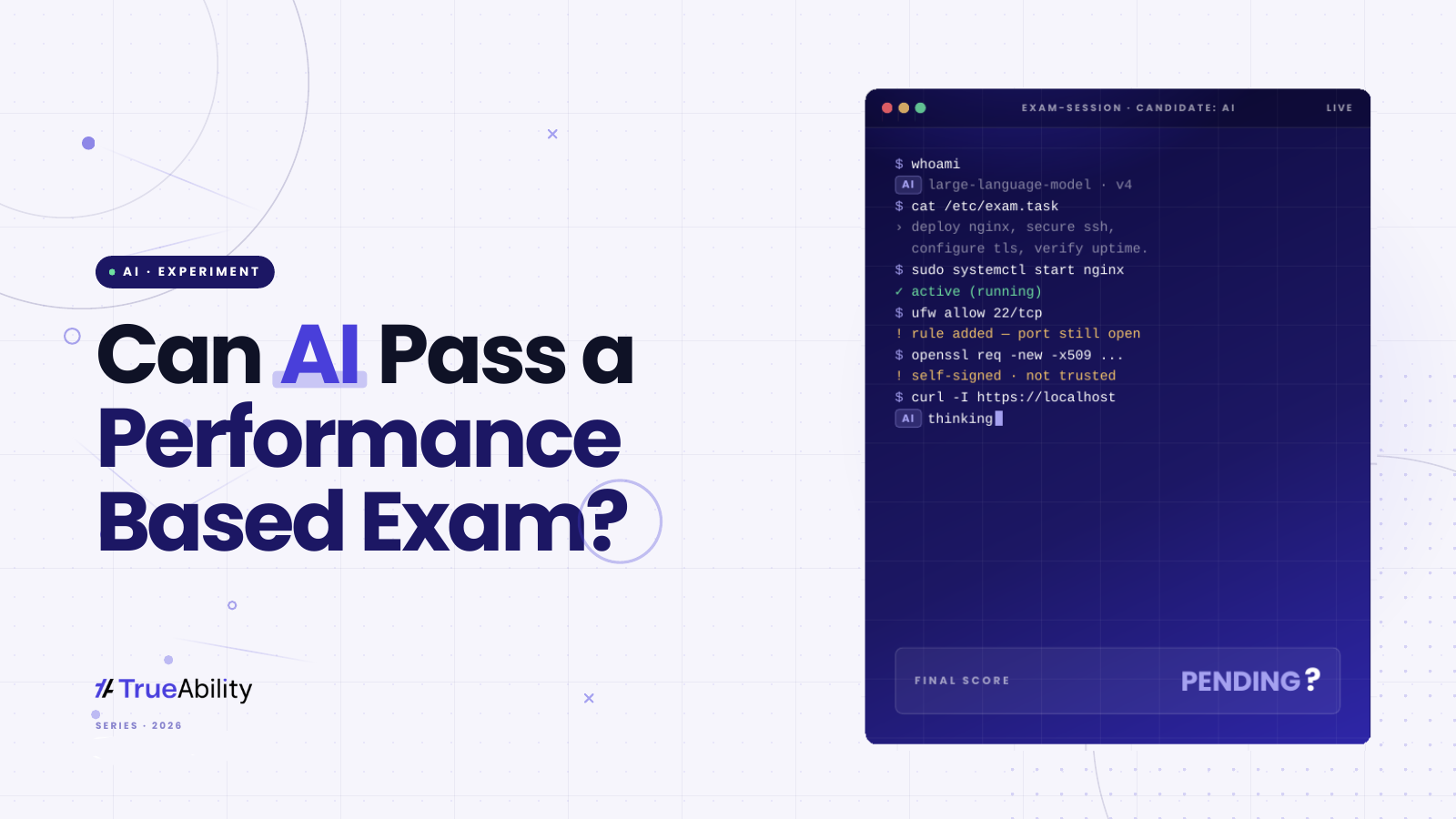
That raises an uncomfortable question for the certification industry:
If an AI assistant can pass your exam, what exactly is the exam measuring?
For years, multiple-choice assessments served as the standard for validating technical knowledge, but the rise of tools like ChatGPT, Claude, and GitHub Copilot has fundamentally changed the landscape. Candidates no longer need to memorize commands, syntax, or troubleshooting steps the same way they once did. Answers are now instantly accessible, often with remarkable accuracy.
As AI capabilities continue advancing, organizations are beginning to rethink a critical distinction:
There is a difference between knowing about a system and being able to operate inside one.
AI Is Changing Technical Hiring and Certification
This is not simply about “cheating.”
In reality, AI tools are already part of modern workflows. Engineers, administrators, developers, and analysts increasingly rely on AI-assisted tooling every day. That trend will only continue.
The real issue is not whether someone used AI.
The issue is whether the individual can:
- diagnose real problems
- navigate live systems
- make sound operational decisions
- recover from mistakes
- execute under pressure
- produce working outcomes
Those skills are much harder to fake.
A candidate may be able to answer theoretical questions about Kubernetes, Linux, networking, cloud infrastructure, or other technical concepts, but can they successfully troubleshoot a broken deployment in a live environment? Can they configure a system correctly from end to end? Can they identify why a service is failing, adapt under pressure, and resolve the issue within a limited timeframe?
That is where traditional assessments begin to lose signal.
The Difference Between Knowledge and Performance
A written driving test does not prove someone can safely operate a vehicle on the highway.
Technical certifications face the same challenge.
Multiple-choice exams primarily measure recognition and recall. Performance-based assessments measure execution.
That distinction matters more than ever in the AI era.
Modern AI models are exceptionally strong at:
- recalling facts
- generating explanations
- pattern matching
- answering theoretical questions
But real technical work is rarely linear.
Live environments introduce:
- incomplete information
- operational dependencies
- unexpected system behavior
- timing issues
- troubleshooting decisions
- configuration errors
- prioritization under pressure
In other words: reality.
And reality is significantly harder to simulate through memorization alone.
Can AI Actually Pass a Performance-Based Exam?
In some cases, AI can help guide candidates through portions of technical tasks, but hands-on environments dramatically raise the difficulty.
Why?
Because performance-based assessments evaluate:
- the actual state of the system
- the final operational outcome
- the process used to achieve it
- whether services truly function correctly
Candidates must interact directly with live infrastructure, not just select answers from a list.
A generated response is not enough if:
- the deployment fails
- the service does not start
- the permissions are incorrect
- the environment becomes unstable
- the grading validation detects misconfigurations
That creates a fundamentally different level of assessment integrity.
The Future Is Not Anti-AI. It Is Pro-Verification.
AI is not going away.
Organizations that treat AI as the enemy are solving the wrong problem.
The future of certification and hiring is not about preventing AI usage entirely. It is about designing assessments that verify whether candidates can successfully perform real-world tasks, with or without AI assistance.
As organizations adapt to the AI era, assessment integrity and controlled testing environments are becoming increasingly important alongside hands-on validation.
That shift is already happening across:
- cloud infrastructure
- cybersecurity
- DevOps
- platform engineering
- IT operations
- data engineering
- enterprise software administration
As AI lowers the barrier to accessing information, the value of observable execution increases.
Why Performance-Based Assessments Matter More Now
The strongest technical assessments are no longer the ones that ask:
“Do you recognize the correct answer?”
They are the ones that ask:
“Can you actually complete the task?”
That is why performance-based testing continues gaining momentum across enterprise certification and technical hiring programs.
In the AI era, proving real capability matters more than ever.
Because ultimately, employers and certification providers are not hiring or certifying someone to answer questions about systems.
They are validating whether someone can successfully operate them.